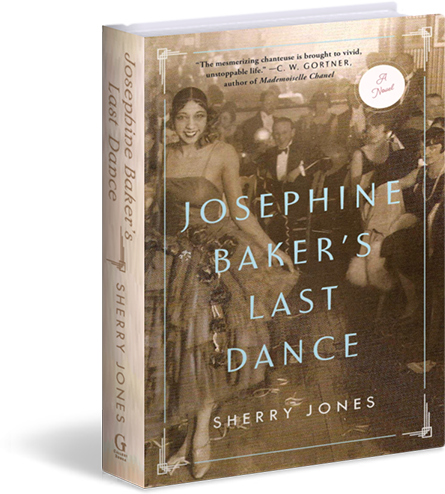
A Brand New Novel
Josephine Baker, the early-20th-century African-American dancer, comic, and singer–hugely famous in Paris. Did you know that she was also a spy for the French Resistance during WWII?

Josephine Baker, the early-20th-century African-American dancer, comic, and singer–hugely famous in Paris. Did you know that she was also a spy for the French Resistance during WWII?
No great writer/artist/performer ever had a happy childhood. I’m a case in point, although my “greatness” as a writer is strictly subjective.
However, my novel “Josephine Baker’s Last Dance” DID *almost* win the Paris Book Festival Award for General Fiction, named first runner-up among hundreds of entries. So there is that.
As for Josephine herself, she was without a doubt a great performer, one of the best who ever lived. Raised in a mixed-race neighborhood in St. Louis, Missouri, she grew up as poor as a church mouse, at one point living in a house whose walls her parents covered with newspaper to keep the wind from whistling through slats between the boards.
St. Louis is a mid-Western town, geographically, and can be very cold in the winter. Josephine said she grew up dancing to keep warm.
She also danced to earn money, doing the Turkey Trot, the Black Bottom, and other colorfully-named local dances in the city’s streets for coins tossed her way. Even a nickel helped put food on the table. Her step-father, Daddy Arthur, suffered from depression and alcoholism and did not keep a steady job. Her mother, Carrie, worked in a laundry at a time when the job entailed scrubbing out stains by hand.
No one knows for certain the identity of Josephine’s father, although some say it was Eddie Carson, a dancer and drummer who performed on stage with Carrie. Josephine’s mother became pregnant out of wedlock and most likely knew that having a child would relegate her to a live of poverty and striving, which it did.
Is this why she said what she did when Josephine was born?
This scene didn’t make it into the final manuscript because my editor at Gallery/Simon and Schuster insisted I whittle down the 160,000-word first draft to 110,000 words. The result made for a tighter, more focused book, but I hate to waste the lively stories that make up this brilliant and much-loved entertainer’s life.
And so, for your reading enjoyment, I present the harrowing, disturbing scene from the birth of one of the greatest entertainers of all time: Josephine Baker. And if you haven’t read the book, or even if you have and want to give a copy to someone, you’ll find links and other resources on my website.
And please write to me or comment here with your impressions. What do you think of this scene?
Do you think that, to become a true artist, it’s necessary to have a hard upbringing?
Can you see from this beginning how Josephine Baker became a model of resilience and resistance to the status quo in a tumultuous world?
Can you understand why she had so many lovers, adopted 12 children, and continued to bathe in the limelight long after she’d passed her prime?
A Star Is Born
The world beckoned to her one Sunday in June. It was about time, as far as she was concerned: she’d run out of room to dance in that small, dark space. She lifted her arms and pointed her toes and leapt toward the light like a swimmer slicing up from the deep toward the sun.
But there was no sun where she was headed, only a bare bulb in the concrete basement, and the Negro doctor called out of church to deliver a baby that the regular staff wouldn’t touch, afraid something — viscera, shit, blackness—might rub off on them. As if Carrie McDonald and her soon-to-be offspring wore shoe polish like the minstrels on the vaudeville stage. Kick, kick, shimmy, shimmy.
Josephine tried a pirouette; invited the doctor to lift her in a pas de deux but he was no dancer. Approaching the patient’s stirruped feet, he could barely keep his focus amid the screams and piercing invectives. Who was this common woman, stinging his ears with her motherfucker, shit! goddammit, oh goddamn, shit! Oh sweet Jesus. Help me, Lord. Ow! Ooooaaahhhh. Oh, you cocksucker! What did you do to me? Goddamn you. Sweet Jesus. Giving birth in a white hospital? She must be somebody’s maid, knocked up by her white employer whom she would never see again.
His heart brimmed with the tears she wasn’t crying and he reached out, wanting to hold her in his arms but she screamed Bastard! Stupid bastard! I hate you! as the crowning head appeared. He moved his hands toward it, spied the shining bald scalp, admired the well-formed skull and skin like toasted caramel, yes, it was as he thought: there was cream in the coffee. Which man had done it? It must be somebody important. One of the doctors here, perhaps. Was he nearby, waiting for his child’s birth?
The head crowned quickly; he took a step forward, then two, holding out his hands as if to catch a pass. The mother gasped. The head rocketed toward his outstretched fingers and suddenly the slick, wriggling infant was slipping past his fumbling palms and plummeting, soft spot first, toward the floor. His yelps echoed about the concrete walls as he lunged forward to grab the baby’s shoulders and his fingertips made sweet contact and then everything became easy.
A song played in his mind, Oh go ‘way man I can hypnotize dis nation, I can shake de earth’s foundation wid de Maple Leaf Rag, and he took a step to the side and slid a hand under the newborn’s head shuffling his feet and he laughed, lifting the child, a girl, in a gentle swoop and turn, moving as gracefully as a dancer, feeling like one. His eyes sought the mother’s face, did she see that move? Her eyes filled with tears and her mouth drooped. He offered her the babe, but she clenched her fists.
“What did you do that for? Are you touched in the head?” she said, taking the infant but continuing to glare at him. He reached for his scissors to cut the cord, mumbled an apology for nearly dropping her newborn.
“It’s almost as though she couldn’t wait to get here, she sailed through the air like a ballerina, it was—”
“You smile like you done something good,” Carrie said. “Damn you. You should have let it fall.”